· Dana Whitfield
Flying With a Car Seat: The Complete 2026 Guide
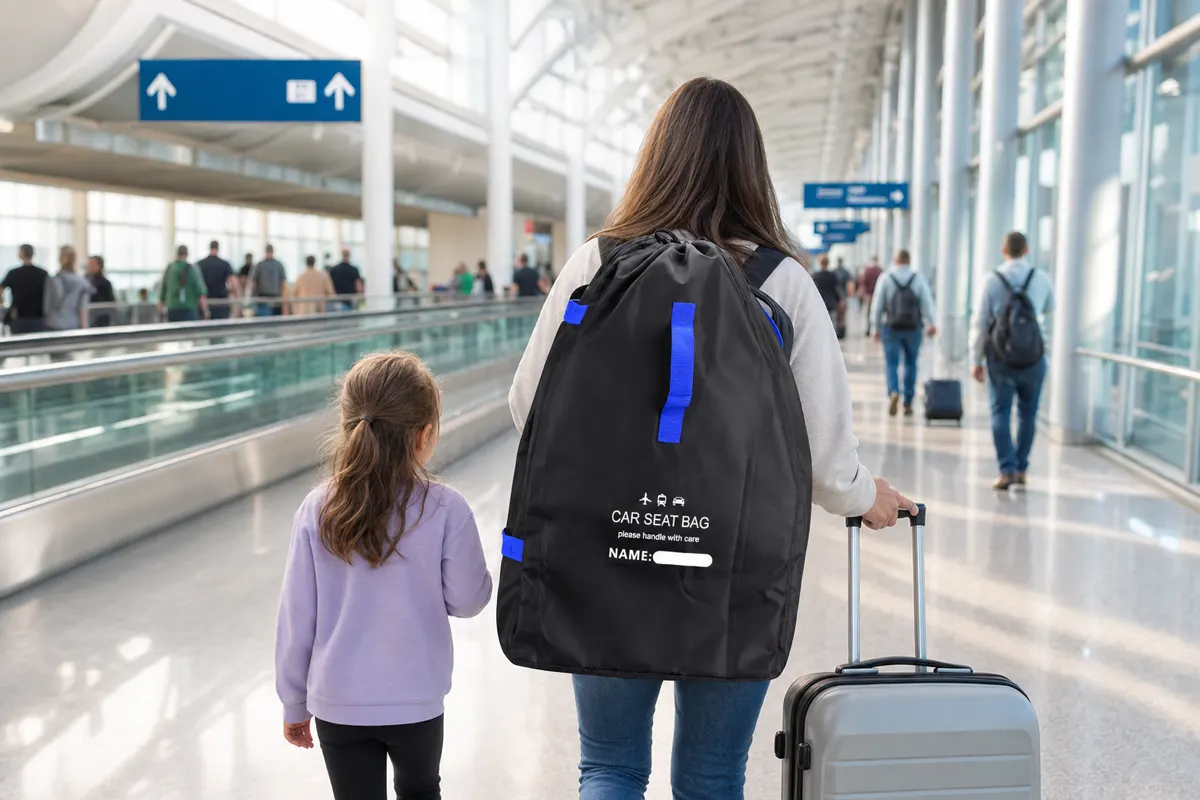
I have flown with a car seat more than sixty times, from quick hops to Orlando to a two-layover slog to Anchorage with a toddler on my hip. This guide covers everything I wish someone had told me before flight number one: whether to buy your child a seat, how the cabin and gate check options actually work, what each airline allows, and how to make sure a seat that costs as much as a mortgage payment survives the trip.
Lap child or their own seat? What the FAA actually says
U.S. airlines let children under two fly on a parent's lap, usually free on domestic routes. It is legal, it is cheap, and almost every new parent does it at least once. I did.
But the Federal Aviation Administration is unambiguous about what it prefers. In its Flying with Children guidance on faa.gov, the FAA states: "The safest place for your child on an airplane is in a government-approved child safety restraint system, not on your lap." (Federal Aviation Administration, Flying with Children guidance, faa.gov.)
The practical translation: if your budget allows, buy your child a seat and install the car seat in the cabin. If you fly as a lap family, you will still bring the car seat for the destination, which means you will gate check it or check it at the counter. Either way, the seat is coming to the airport with you, so the rest of this guide applies no matter which ticket you book.
Your three options, compared
Here is the decision in one table. I go deeper on each option below.
| Option | Cost | Best for | Risk to the seat |
|---|---|---|---|
| Use it in the cabin | Price of a child ticket | Children under ~40 lb, safety-first families | Lowest — it never leaves your hands |
| Gate check | Free on majors | Lap infants, families who need the seat until boarding | Moderate — short trip to the hold, use a bag |
| Check at the counter | Free on majors | Anyone who wants hands free through security | Highest — full baggage journey, use a padded or sturdy bag |
Option 1: use the car seat in the cabin
This is the FAA-recommended setup, and after trying all three options, it is my favorite for children under two. A child who rides to daycare in a car seat every day treats the airplane version as familiar territory. Mine napped in the air in ways a lap child never did.
Requirements to know before you board:
- The seat must be aircraft-certified. Look for the label on the seat shell stating it is certified for use in aircraft. Nearly every U.S.-sold infant and convertible seat has it; boosters do not, because boosters need a lap-and-shoulder belt that airplane seats lack.
- Your child needs a purchased seat. You cannot install a car seat over a lap-infant ticket. Some airlines discount infant fares; always worth asking.
- Window seat placement. Airlines require the car seat at the window (or the center of a middle section) so it never blocks an escape path.
- Width matters. Most economy seats run 16 to 18 inches between armrests. Slim convertibles install easily; wide ones can be a wrestle. Check our fit notes for the Graco 4Ever and Chicco KeyFit 30 before you fly.
Even when the seat rides in the cabin, I still bring my car seat travel bag folded into its built-in pouch. Plans change: an equipment swap, a full flight, a gate agent who measures your seat and shakes her head. The bag turns that moment from a crisis into a shrug.
Option 2: gate check the car seat
Gate checking means you keep the car seat through security and all the way to the boarding door, then hand it off to be loaded below. You get it back either at the jet bridge on arrival or at baggage claim, depending on the airline and airport. It is free on every major U.S. carrier.
This is what most lap-child families do, and it is what I did for years. The seat stays useful right up until boarding: my son sat buckled in his familiar seat at the gate while I ate a sandwich with two free hands.
The catch: a gate-checked seat still rides in the cargo hold, gets stacked under strollers and other gate-checked gear, and crosses a rainy tarmac in an open cart at some airports. According to SITA's Baggage IT Insights, airlines mishandled 7.6 bags per 1,000 passengers in 2023 — and that number covers standard luggage that was designed to be thrown. A naked car seat has harness straps that snag on conveyor rollers and foam that is not rated for impact against a metal cart.
The fix costs less than airport parking: a gate check bag. Ours is 33 x 17 x 17 inches, swallows infant seats, toddler seats, and full convertibles, and closes with a drawstring in about ten seconds at the gate. I wrote a full walkthrough in how to gate check a car seat, step by step.
The bag I actually use: the SeatPorter Car Seat Travel Bag — water-resistant Oxford cloth, padded backpack straps so I can carry the seat hands-free with a kid on each side, a NAME window so it never gets confused with another family's seat, and a built-in pouch it folds into when empty. Black or Blue, $24.99.
Option 3: check the car seat at the counter
Counter checking (also free on the majors — see do car seats fly free?) means the seat travels like a regular checked bag: conveyor belts, sort systems, carts, the works. Choose this when you will not need the seat before the flight and you would rather move through security unencumbered.
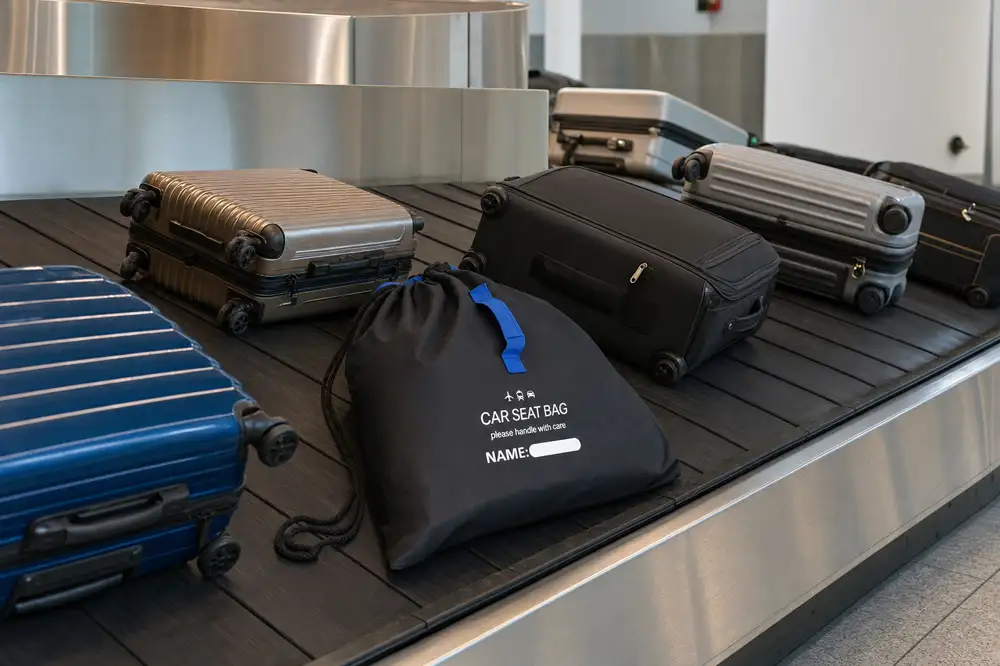
Because the seat takes the full baggage journey, protection matters more here than anywhere else. At minimum, use a sturdy travel bag with the harness straps tucked inside. If you fly monthly or check a top-shelf convertible, a thick padded bag is a reasonable upgrade — I compare the options honestly in my car seat travel bag comparison.
One more reason to bag it: a typical convertible car seat lists for $200 or more at 2026 manufacturer prices. A $24.99 bag protecting a $200+ seat is the cheapest insurance in travel.
Why the travel bag is non-negotiable for me
Three trips convinced me, and I have tested bags formally ever since (here is how we test):
- A friend's unbagged seat came off the carousel with a cracked base clip. The airline's response was a shrug and a form.
- Denver, February: gate-checked gear rode to the plane in an open cart through active snowfall. Bagged seats arrived dry; the rest did not.
- My own seat once arrived with someone else's stroller hooked through the harness. Since then, straps stay inside a bag.
Beyond protection, a bag with backpack straps changes the physics of the airport. A convertible seat is an awkward, bulky carry with no good handhold. On your back, it disappears, and your hands go back to boarding passes and small humans. Verified buyers say the same thing in our reviews.
My airport checklist for flying with a car seat
- Before the trip: confirm your airline's car seat policy online; verify the aircraft-certified label if using it in the cabin; practice the bag-up once at home.
- Packing: tuck harness straps and chest clip inside the shell; remove cup holders and loose accessories; slide your contact card into the NAME window.
- At check-in: checking at the counter? Bag the seat and get the tag here. Gate checking? Just ask for the gate tag now so you skip the podium line later.
- At the gate: bag the seat while boarding starts, tag on the outside, drop it at the end of the jet bridge with the strollers.
- On arrival: gate-checked items usually come back at the jet bridge — but on some airlines and international arrivals they go to baggage claim. Ask the flight attendant before you land.
Traveling with a stroller too? The routine is nearly identical — I cover it in the stroller gate check guide, and our stroller travel bag pairs with the car seat bag in the Complete Travel Set.
Airline by airline: the big three
Policies converge on one happy fact: on every major U.S. carrier, car seats and strollers fly free, both as checked and gate-checked items, and they do not eat into your baggage allowance (American, Delta, and United policies, 2026). Details worth knowing:
| Airline | Car seat checked/gate | Notes from my flights |
|---|---|---|
| American | Free | Gate tags issued at the podium; agents routinely allow cabin use if an adjacent seat is open — ask nicely at the gate. |
| Delta | Free | Gate-checked seats usually returned at the jet bridge; smooth even at busy hubs like ATL in my experience. |
| United | Free | Free for the car seat and the stroller; get the tag at check-in to save a step at the gate. |
Other large U.S. carriers follow the same free-car-seat practice, but policies live on airline websites and change — check yours the week you fly, especially for international itineraries and partner-operated legs.
The bottom line
Buy the seat in the cabin if you can — that is the FAA's advice, not mine. Gate check when you cannot, counter check when you want free hands, and never hand your car seat to an airline naked. Sixty-plus flights in, the bag is the one piece of gear I have never regretted packing.