
· Dana Whitfield
Wheeled vs Backpack Car Seat Travel Bag: Which One Survives the Airport
Every car seat travel bag has to answer the same first question: how does an object the size of a laundry basket cross a terminal built for rolling suitcases? The market has settled on two serious answers — put wheels under it, or put it on your back — and I have flown with both. This piece is the head-to-head: where each carry moves well, where each one stops dead, what the cargo hold does to each, and which one matches which trip. If you are still weighing all four bag categories, drawstring and padded included, the full field is compared in the best car seat travel bag guide; if you already know it comes down to rolling versus wearing, stay here.
Same disclosure I give in every comparison: SeatPorter makes the backpack-strap kind, at $24.95, and I will tell you plainly where wheels beat it. They do beat it — on exactly one kind of walk.
The two carry systems at a glance
A wheeled bag is a travel bag with two wheels at one corner and a drag handle at the other, typically $40-70. A backpack bag is the same protective shell with padded shoulder straps sewn on, typically $20-30. The shell does the protecting either way; everything that separates them is about movement.
| Wheeled bag | Backpack bag | |
|---|---|---|
| How the seat moves | Rolls behind you, tilted on two wheels | Rides on your back |
| Hands | One hand pulls, permanently | Both free |
| Long smooth concourse | Excellent — this is its home turf | Fine, but the weight is on you |
| Curbs, stairs, escalators | Carry it anyway, now with wheels attached | No change: it is a backpack |
| In the hold | Wheels and handle can snap under thrown luggage | Straps clip flat, nothing protrudes |
| At the destination | Stays a bag-sized object all week | Folds into its own zip pouch |
| Typical price | $40-70 | $20-30 |
Where wheels genuinely win
Put a big convertible seat in a bag and it is heavy — there is no talking around that. Wheels take that weight off your body entirely, and on the right floor they are glorious: a long, polished concourse, a moving walkway, a mega-hub where your connection is a fifteen-minute walk on one level. If your seat is a large convertible and you are traveling alone, without a stroller, the drag handle is doing a job your shoulders would otherwise do.
That is the wheeled bag's case, and it is real. A solo parent flying the same two smooth-floored hubs every month, hauling a full-size convertible, no stroller in the party: that traveler is rolling, and should be. I have watched parents do this glide past me at my own home airport and understood the appeal completely.
Notice how specific the conditions are, though. Heavy seat, long flat floor, a free hand to spare, no stroller in play. Change any one of those variables and the picture flips — which is what the rest of this comparison is about.
Where the rolling stops
Airports are advertised as smooth floors and are actually a series of transitions: the curb at drop-off, the gap onto the terminal train, the escalator down to baggage, the shuttle bus step, the cobbled taxi rank on the other end. At every one of those, a wheeled bag becomes a carried bag — the heaviest kind, because now you are lifting the seat plus the wheels, the axle, and the drag handle that came with them.
The handle itself has a cost nobody mentions in product photos: it occupies one hand for the entire walk. Parents do not have a spare hand. The hand that pulls the bag is the hand that cannot hold a toddler at the checkpoint queue, cannot push a stroller, cannot carry the coffee. My write-up of the curb-to-gate walk breaks the journey into four legs, and the pattern holds on every one of them: the terminal rewards whatever leaves your hands free.
There is also a weight paradox built into the category. Wheels, axle, and frame add heft to the bag itself, and that surcharge follows you onto every stair and shuttle step — precisely the places where the wheels have stopped helping. The bag designed to spare your arms asks the most of them at the terminal's hardest points.
Security is a transition too. The seat goes bare onto the X-ray belt, so whatever bag you brought is now a separate object to manage. A backpack bag folds into its pouch and rides through in a bin. A wheeled bag cannot fold — the wheels and frame see to that — so you send an empty, bag-sized shell down the belt and haul it off at the other side, one-handed, while your child watches the bins.
What gate check does to wheels
Here is the part I flag for every parent who asks: the airport moment that decides this comparison is not the concourse, it is the hand-off. When you gate check a car seat, the bag leaves you at the end of the jet bridge and gets hand-loaded into the hold with the strollers — quickly, in a stack, by someone with nine other things to load. Counter check it instead and it rides the full conveyor network: belts, sorters, carts, carousel.
checked bags mishandled per 1,000 passengers worldwide
— SITA Baggage IT Insights, 2023
fee to check a car seat on major US airlines, counter or gate
— American, Delta, and United policies, 2026
Neither journey is gentle, and neither cares what your bag cost. Wheels, axles, and telescoping handles are rigid parts that stick out from the bag's body, which is why they are the first thing to break in the hold: a suitcase dropped on a wheel housing does what physics says it does. A backpack bag has nothing to snap — the straps clip flat against the shell so they do not snag on conveyor rollers, and the rest is fabric.
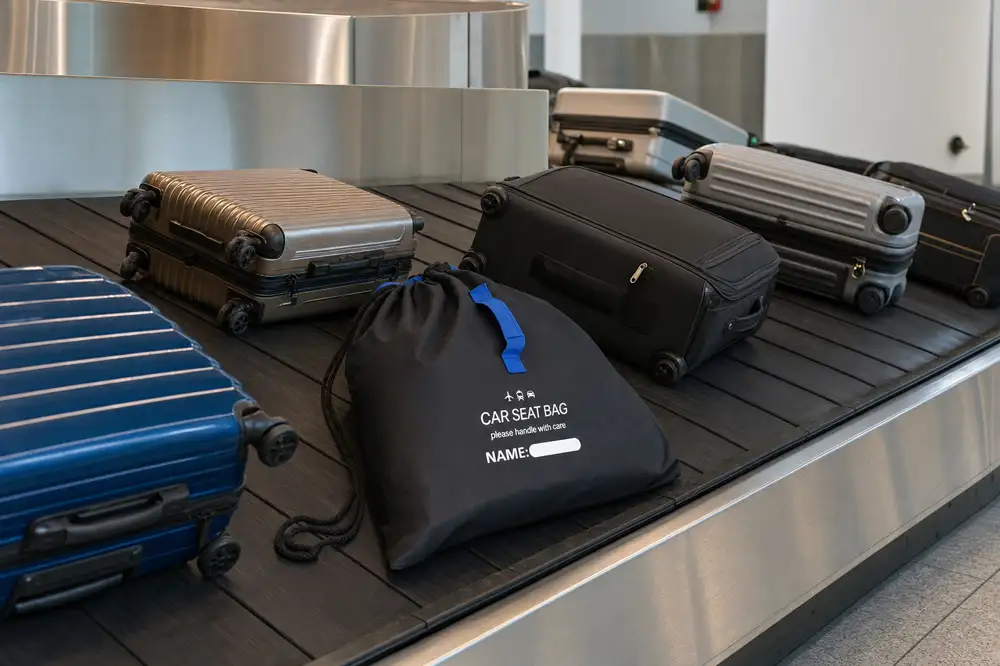
And a wheeled bag with a snapped wheel is not a wheeled bag anymore; it is the bulkiest hand-carry bag in the terminal, for the rest of the trip. The seat inside is usually fine — the shell did its job — but the feature you paid the premium for is gone at the moment you have the least capacity to improvise. What the hold actually does to seats, and how to inspect yours on arrival, is covered in do checked car seats get damaged.
The stroller test
The fastest way to settle wheeled versus backpack is one question: is a stroller flying with you?
If yes, the decision is nearly automatic. A stroller already occupies your hands to the boarding door — that is where it earns its keep, as the stroller gate check guide lays out. You cannot push a stroller and pull a wheeled bag with the same two hands. The backpack carry is built for exactly this shape of family: seat on one adult's back, stroller rolling in front, and every finger still accounted for.
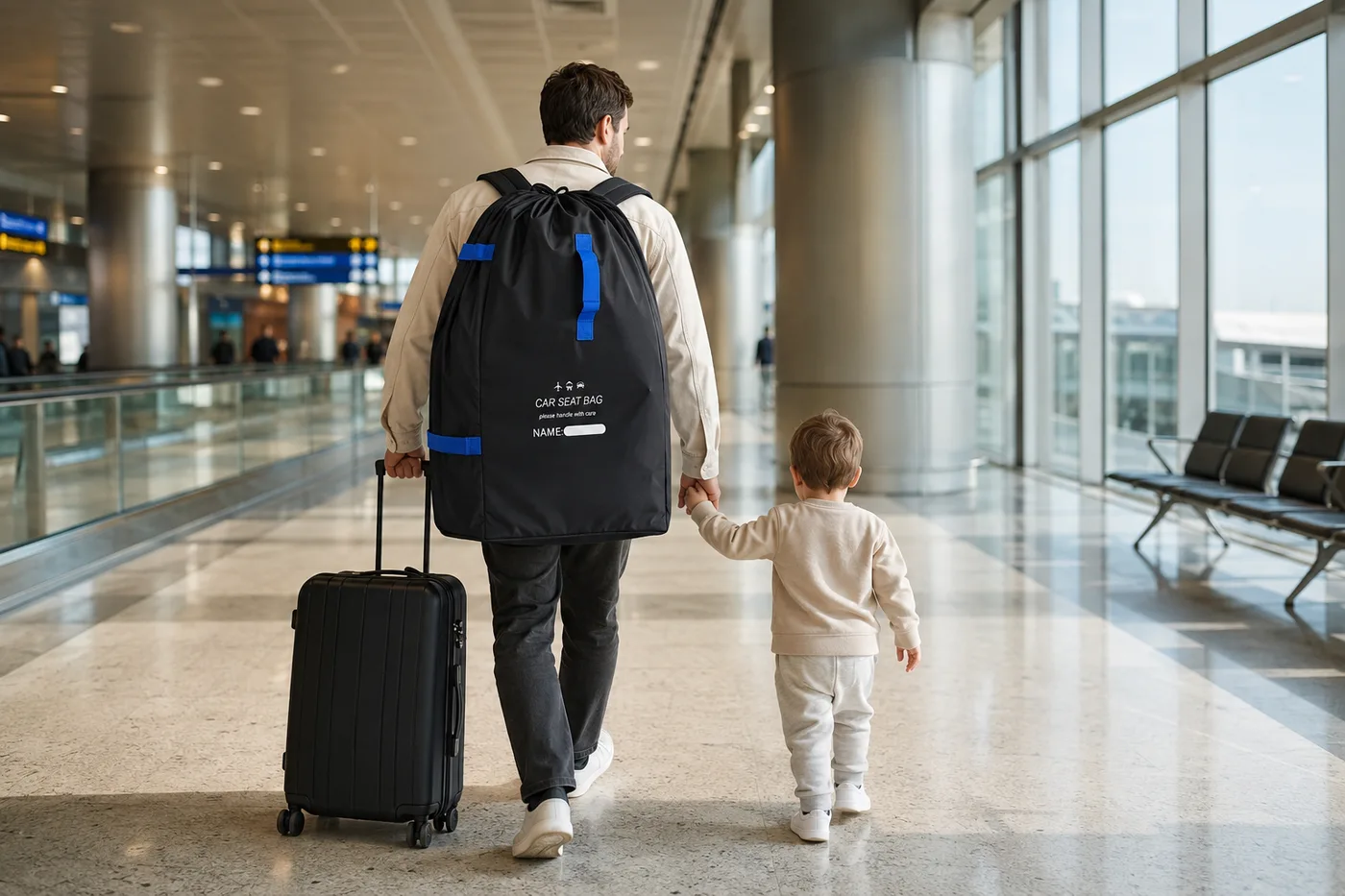
The stroller also quietly deletes the wheeled bag's whole argument. Families who fly with one often find the stroller basket carries the bagged seat perfectly well — the stroller becomes the wheels. At that point a wheeled bag is redundant rolling: you paid extra, and packed extra bulk, for a feature your stroller already provides free.
If no stroller is flying with you, go back to the wheels-win conditions above and check them one by one. Solo, heavy convertible, smooth single-level route: roll. Two adults, or an infant carrier light enough to wear without thinking about it: the straps take it. And if you sit between those cases, choose for the way you fly most often, not for the one heavy trip you might take someday.
After you land, the bag is still with you
Comparisons always end at the carousel, but the bag does not. It comes along for the week — into the rental car trunk next to the luggage, into the hotel room, back again on the return.
A backpack bag with a built-in pouch disappears for that week. Ours folds into its own zip pouch and lives in the stroller basket or a diaper bag until the flight home; at the return airport it unfolds in a minute at the gate. A wheeled bag cannot do this. The frame, wheels, and handle keep it bag-sized whether the seat is inside or not, so it spends the vacation as one more object in a trunk that was already full. On the day you fly home, you repeat the whole exercise in reverse, usually with more luggage and less patience.
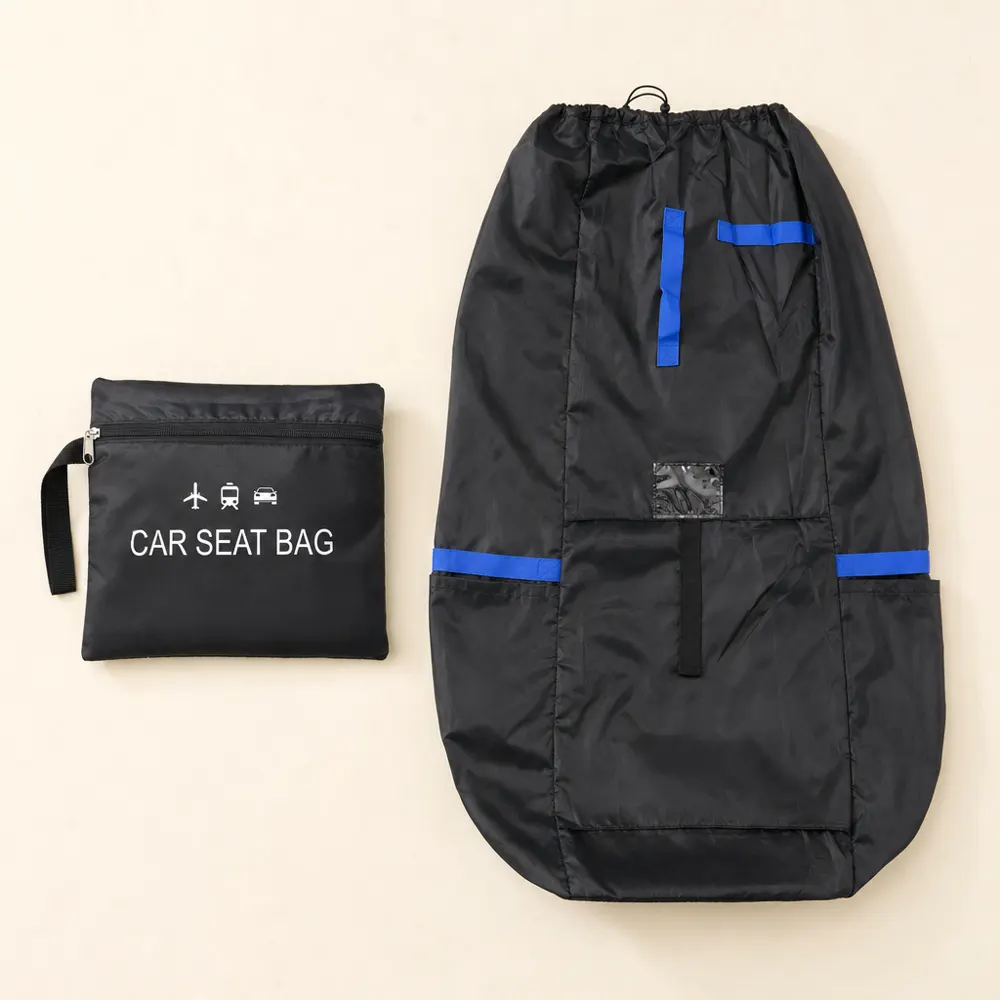
The same logic follows you home. A folded backpack bag stores in a closet corner or the seat box itself between trips. The wheeled bag needs shelf space year-round — a small thing, until you live with it.
The decision, by trip
Line your travel pattern up against the row that matches, and trust the row over the marketing.
| Your trip | Roll or wear |
|---|---|
| Solo parent, heavy convertible, long smooth concourse, no stroller | Wheeled — this is the trip the wheels are for |
| Family flying with a stroller | Backpack — hands push the stroller, the seat rides your back |
| Gate checking most flights | Backpack — nothing rigid to snap at the jet-bridge hand-off |
| Connections, terminal trains, shuttle buses, escalators | Backpack — every transition is a place wheels stop rolling |
| Tight packer: small trunk, small closet, gear audit every trip | Backpack — it folds into its own pouch and vanishes |
One row for wheels, and I mean it — that solo-parent, heavy-seat, flat-floor trip is real, and a wheeled bag serves it well. Every other pattern I see at the gate resolves to the straps, because airports are transition machines and hands are the scarcest resource in them.
If the straps side fits your trips
The backpack bag we make is the SeatPorter Car Seat Travel Bag: a 33 x 17 x 17 inch (85 x 45 x 45 cm) water-resistant Oxford cloth shell that takes infant carriers, toddler seats, and convertibles with the headrest lowered. Padded, adjustable shoulder straps plus a top handle for carousel grabs, a NAME window so your black bag is provably yours at the jet bridge, and the built-in zip pouch the whole bag folds into. Black with blue straps, $24.95. The full backpack-carry breakdown — strap setup, packing so the load does not shift, wearing it with a stroller — is on the car seat backpack page.
Ready to wear the seat instead of dragging it? The SeatPorter bag is $24.95, ships free, and comes with a 30-day money-back guarantee. Flying with two seats, or a stroller too? The 2-Pack and the Complete Travel Set are both $44.95.

Dana Whitfield · Family Travel Gear Tester
Mom of two, 60+ flights with car seats in tow. I test every bag on real airport days: gate checks, rain on the tarmac, and baggage carousels.